
Automating a CNC lathe or mill: cobot, robot, gantry loader or pallet system?
You can automate loading and unloading a CNC lathe or mill with a cobot, a fenced industrial robot, a gantry loader built into the lathe, or a workpiece changer or pallet system on a machining center. Which one fits depends on what the gripper and part weigh together, how far the arm has to reach, whether people work beside it, and whether your machine's builder makes a loader for it.
Published Nov 10, 2026
What is machine tending, and what are the options?
Machine tending is the part handling at a CNC machine: setting blanks in, taking finished parts out, and moving them to and from storage. Automating it hands that work to a robot or a loader, so people are free for other work and the machine can run hours nobody is staffing.
- A cobot: a collaborative robot arm that, after a proper risk assessment, can usually work beside people in a shared space. FANUC's CRX series is one line of them.
- A fenced industrial robot: a traditional robot arm, working behind fencing.
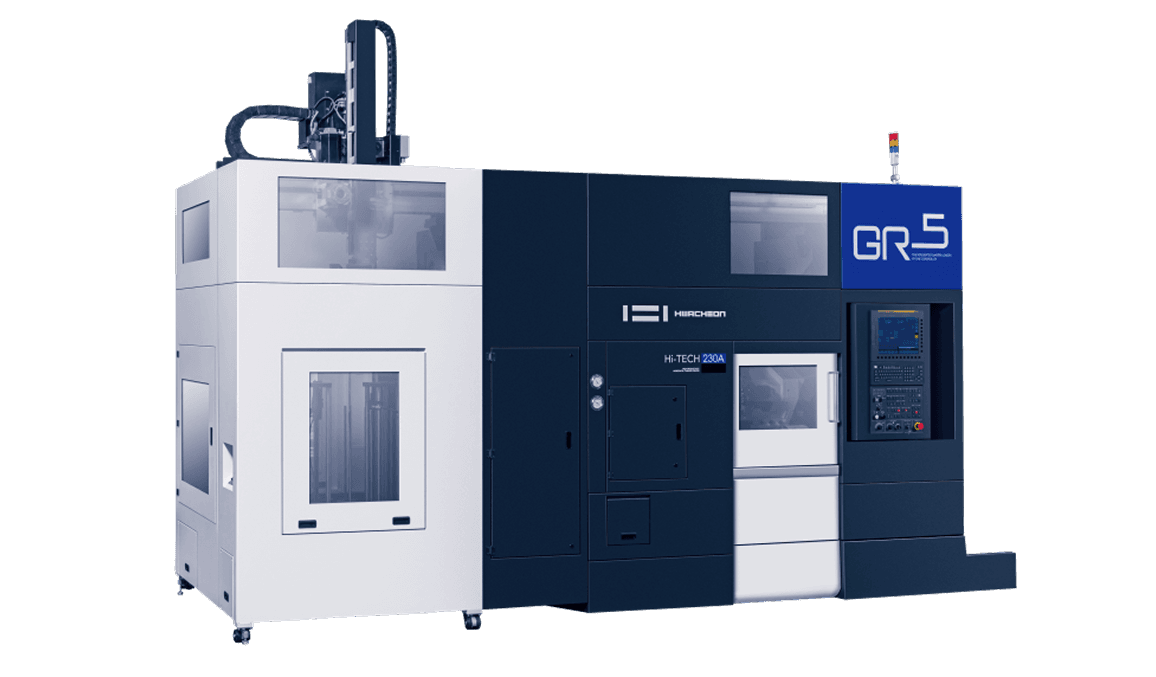
- A gantry loader: a loader built into the lathe, like Hwacheon's GR Series, which runs from the lathe's own CNC.
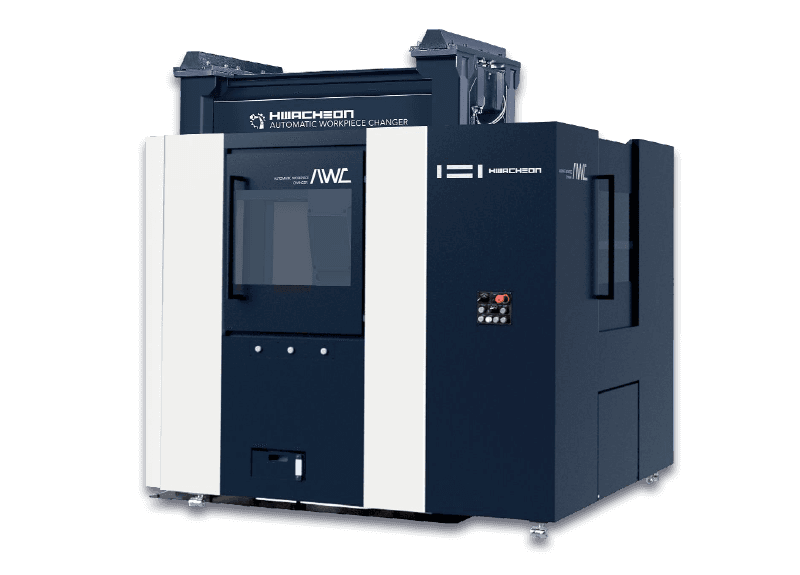
- A workpiece changer or pallet system: people load holders or pallets at a separate setup station, and the system swaps them in and out of a machining center, like Hwacheon's AWC for 5-axis machines and its HMP multi-pallet system.
What should you work out before choosing?
FANUC's article on cobot machine tending puts ten questions to a shop deciding whether a cobot fits. The ones that decide the hardware:
- Payload: the gripper plus the part, weighed before machining. The heavier the payload, the slower the arm may have to move, which can lengthen the cycle.
- Reach: how far the arm has to extend sets how close it stands to the machine, and how it has to load the part sets how many axes of motion it needs.
- Gripping: rectangular or round parts with two parallel sides suit a pincer-style gripper, and thin or flat parts suit vacuum cups. Changing grippers takes time, so pick one that handles the range of parts you run.
- Presentation: cobots work best where every part waits in exactly the same spot, in a space that is structured, predictable and clear of clutter.
- People and space: whether people will share the area, and how tight it is (the next section).
- Programming: a cobot can be taught by moving its arm through each step. For shops that write G-code, FANUC's QSSR G-code lets the robot's motion be controlled in G-code through a FANUC CNC.
- The link to the CNC: a tending robot often has to exchange signals with the machine's control, so the robot and the CNC have to be integrated.
The rest of FANUC's list is the business case: what you want off people's hands, hiring, and adding hours without adding staff.
Cobot or fenced industrial robot?
Start with the space and the people in it. A proper risk assessment has to be done, FANUC says, but a cobot can usually work alongside skilled workers in a shared space. In a tight space, FANUC notes, the fencing a traditional industrial robot needs ruled it out for many smaller shops.
Then hold the payload up against the arm's rating. FANUC's CRX page lists its CRX cobots from 3 kg of payload and 692 mm of reach (CRX-3iA) to 30 kg and 1,756 mm (CRX-30iA), and names machine tending among the jobs for the CRX-5iA (5 kg, 994 mm) and the CRX-10iA/L (10 kg, 1,418 mm). If the gripper and blank weigh more than an arm's rating, that arm is out, whatever else fits.
What does Hwacheon build for its own machines?
Hwacheon's automation line has three systems: the GR gantry loader for lathes, the AWC workpiece changer for 5-axis machines and the HMP multi-pallet system for machining centers. Each catalog names the Hwacheon models in its line-up, and for the GR and the AWC Hwacheon asks for a technical consultation before pairing one with any other machine.
| System | Its catalog lists it for | Part size | Part weight | Storage |
|---|---|---|---|---|
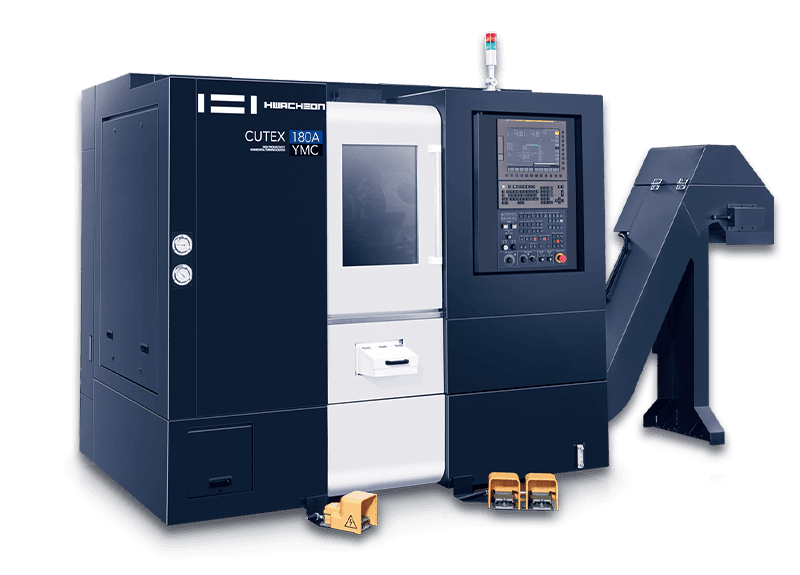
| GR-5 gantry loader | CUTEX-180 A/B, Hi-TECH 230 A | Ø1.89 to Ø6.1 in (Ø48 to Ø155 mm), 0.79 to 4.33 in (20 to 110 mm) long | 11 lb (5 kg) | 10 or 14 station stocker |
| GR-10 gantry loader | Hi-TECH 230 B/C | Ø2.56 to Ø7.87 in (Ø65 to Ø200 mm), 0.79 to 4.33 in (20 to 110 mm) long | 22 lb (10 kg) | 10 or 14 station stocker |
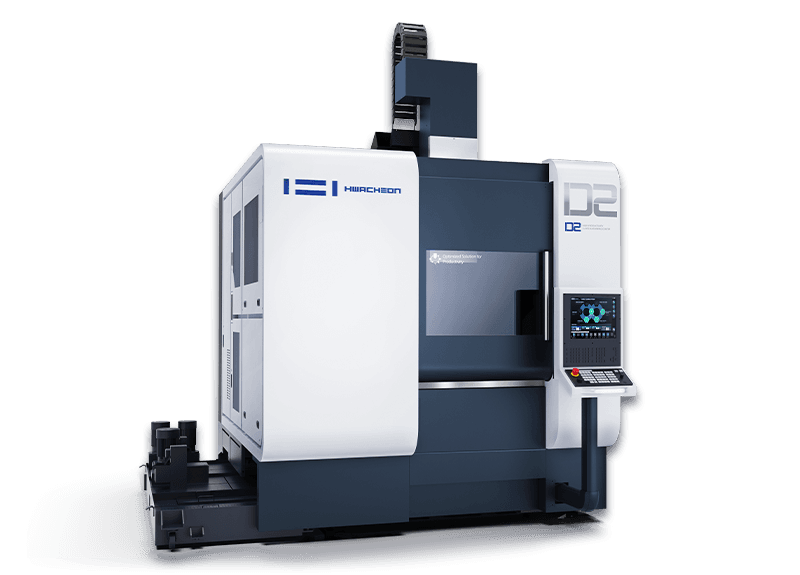
| AWC, 8P or 20P | D2-5AX, M1-5AX | 16.54 x 6.69 in (420 x 170 mm), or Ø11.81 in (Ø300 mm) | 176.37 lb (80 kgf), holder included | 8 or 20 positions |
| AWC, 40P | D2-5AX, M1-5AX | Ø5.91 in (Ø150 mm) | 66.14 lb (30 kgf), holder included | 40 positions |
| HMP-300 pallet system | SIRIUS, SMART and VESTA models (below) | 19.69 x 19.69 in (500 x 500 mm), or Ø21.65 in (Ø550 mm); maximum height 5.51 to 13.39 in (140 to 340 mm) | 661 lbf (300 kgf) | Pallets on 1 to 4 levels |
GR Series gantry loader, for lathes
Hwacheon builds the GR into the lathe mechanically and electrically, so the two ship and install as one unit and run from the lathe's own CNC. A load and unload takes 8 seconds on the GR-5 and 10 on the GR-10, and round parts wait in the stocker, stacked up to 23.62 in (600 mm) high. Its catalog lists it for the CUTEX-180 and the Hi-TECH 230, and also shows two lathes linked by the gantry, with the part turned over between them.
AWC workpiece changer, for 5-axis machines
Parts are clamped on HSK-T100 work holders at a setup station beside the machine, and the changer swaps holders in and out of the machine. Its catalog lists it for the D2-5AX and the M1-5AX. The weight limit includes the holder, and the 8, 20 and 40 position versions come with 2, 4 and 6 standard holders, so count the holders and fixtures your part mix needs.
HMP multi-pallet system, for machining centers
Hwacheon's HMP-300 catalog describes a linear multi-pallet system for 3-axis machining centers. Its loading station holds pallets on one to four levels, depending on part height and the machine's work area, and people load the pallets at a setup station that a crane (hoist) can reach. It is built in modules that can stand in one or two rows and serve more than one machine.
The catalog lists it for the SIRIUS-UM+, SIRIUS-UL+ and SIRIUS-UZ, the SMART Ua STEEL, and the VESTA-1000+, VESTA-1300, VESTA-1300B and VESTA-2000.
Hwacheon's HMP web page links that catalog but describes a rotary multi-pallet system: Ø400 or Ø500 pallets, one or two machines per system, and its D Series and M Series 5-axis machines in the line-up. The HMP figures in the table are the HMP-300's.
Of Hwacheon's horizontal machining centers, the H6, H8 and AF-4 each have two pallets. The guide to vertical and horizontal machining centers covers when an HMC makes sense.
What does a tending cell include?
A robot cell is more than the arm. Going by FANUC's questions, plan for each of these:
- The robot, sized for payload and reach.
- Grippers for the parts you run.
- A way to present every part in the same spot.
- The link between the robot and the machine's CNC.
- Safety: the risk assessment, and fencing where the robot needs it.
- Programming, by moving the arm by hand, from a teach pendant, or in G-code on a FANUC CNC.
Hwacheon's GR folds several of these into the lathe: it runs from the lathe's own CNC and brings its own stocker, so the control link and the part storage come with it.
Who builds a cell for a machine bought from Eagle?
Our automation company, Eagle Automation, a FANUC Authorized System Integrator, builds FANUC robot cells, machine tending and turnkey automation for any machine we sell. On our quote form, check the box for robot loading or automation.
Common questions
What is machine tending?
The part handling at a CNC machine: setting blanks in, taking finished parts out, and moving them to and from storage. Automating it hands that work to a robot or to a loader built for the machine.
Does a cobot cell need a risk assessment?
Yes. FANUC says a proper risk assessment has to be done, but a cobot can usually work alongside skilled workers in a shared space. A traditional industrial robot needs fencing.
What payload does a tending robot need?
Enough for the gripper and the part together, with the part weighed before machining: FANUC counts both as payload. A heavier payload can also mean slower arm moves and a longer cycle.
What loaders does Hwacheon build for its lathes?
The GR Series gantry loader, the system in Hwacheon's automation line built for its turning centers. Its catalog lists the GR-5 for the CUTEX-180 A/B and Hi-TECH 230 A and the GR-10 for the Hi-TECH 230 B/C, with a technical consultation for any other machine. The GR-5 handles round parts up to 11 lb (5 kg) and the GR-10 up to 22 lb (10 kg), with a load and unload of 8 or 10 seconds, from a 10 or 14 station stocker.
Sources
- 1.10 Questions to Determine if a Cobot Is Right for Your Machine Tending Application, FANUC America · fanucamerica.com
- 2.CRX Collaborative Robot Series, FANUC America · crx.fanucamerica.com
- 3.GR Series, The Integrated Gantry Loader: Hwacheon catalog (PDF) · hwacheon.com
- 4.Automatic Workpiece Changer (AWC): Hwacheon catalog (PDF) · hwacheon.com
- 5.HMP-300 Linear Type Multi Pallet System: Hwacheon catalog (PDF) · hwacheon.com
- 6.HMP, Multi-Pallet System for High-Mix Continuous Production: Hwacheon product page · hwacheon.com